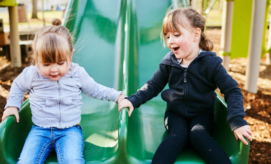


Maria Montessori famously said that “play is the work of the child,” reminding parents and educators that children need playful experiences to learn and grow. As educators and caregivers, we know that young children build physical, cognitive, social, and emotional skills through playful interactions with their peers, and so we dedicate a large part of the ECE day to play and play-based learning.
A few recent articles have highlighted the importance of play, as a way to support children’s learning, development, and preparation for elementary school. They offer research that reinforces the ECE focus on play-based learning.
Why schools — now more than ever — should let young kids learn through play (not worksheets). An article from Washington Post that includes a piece written by Nancy Carlsson-Paige, an early childhood development expert, an education professor at Lesley University, a founding member of a nonprofit organization called Defending the Early Years, and the author of the book Taking Back Childhood: A Proven Roadmap for Raising Confident, Creative, Compassionate Kids.
Experts: For Early Childhood, Play Is Best. This article in Forbes recaps a panel discussion hosted by Defending the Early Years during their summer institute. During the discussion, William Doyle, an educational advisor, Nancy Carlsson-Paige (noted above), and Pasi Sahlberg, an educator and author from Finland, weighed in on the importance of play in children’s academic experiences.
Play in Early Childhood: The Role of Play in Any Setting. This video from The Center on the Developing Child at Harvard University that shares how play is an important tool for supporting responsive relationships, strengthening core life skills, and reducing sources of stress.

Free Online Modules from the Institute of Learning & Brain Science 

Momentum Building for Early Childhood Support