

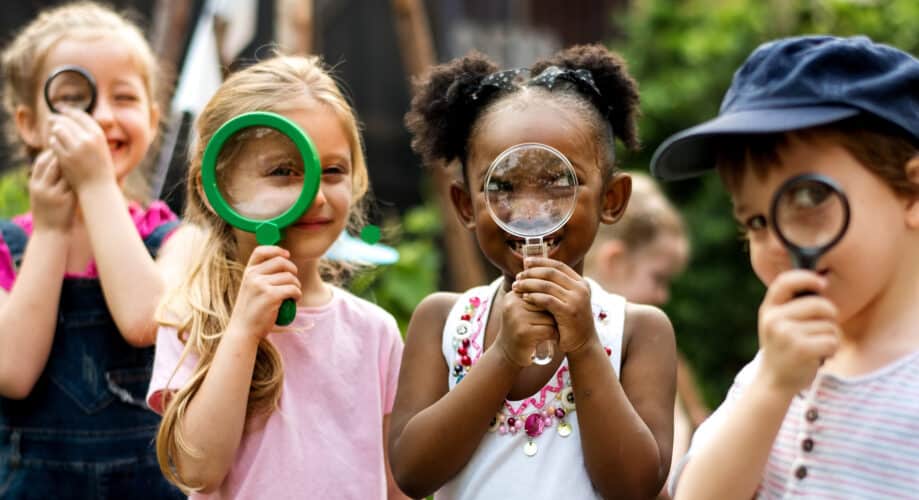
Young children are natural scientists. They express their inquisitiveness by asking lots of questions, experimenting with cause and effect, and exploring the world around them. These moments are the foundation of STEAM learning, a model of exploration that combines science, technology, engineering, art, and math.
In this article, we explore the “S” in STEAM, which stands for science. You’ll find information about what science looks like in early learning classrooms, how it supports kindergarten readiness, and ideas for incorporating scientific learning with the little ones in your care.
In early childhood, science is about wonder and curiosity. An article from Head Start.gov notes, “Science is not just a body of knowledge—it’s a way of thinking and acting, a way of trying to discover the nature of things. Science learning at any age involves curiosity, exploration, and discovery…(Young children) explore physical, natural, and social science anywhere and everywhere. They observe, are curious, and investigate to find out more about their world. They gather information as they solve problems.”
In early learning classrooms, exploring scientific concepts often looks like play, such as when little ones mix paint colors or compare the sizes of leaves in the yard. Through these experiences, children ask questions, test ideas, and form hypotheses, which are all important parts of scientific thinking.
The National Association for the Education of Young Children (NAEYC) explains, “Curiosity motivates children to learn and try new things and is a fundamental scientific attitude. The most important thing adults can do to promote children’s science learning is to nurture their curiosity.” When educators embrace children’s innate sense of exploration, we can help to set children up for success in future academics and STEAM learning.
Science exploration during early childhood helps little ones develop tools for making sense of their world. Experience using these tools will equip them to approach challenges with confidence. When children explore scientific ideas through playful hands-on activities, they develop important cognitive and social-emotional skills, including…
Science learning is most engaging when young children can explore scientific concepts through playful activities and everyday classroom routines that nurture curiosity and allow children to take the lead.
An article from the National Center on Early Childhood Development, Teaching, and Learning provides a description of the scientific method. “The scientific method includes observing, forming questions, making predictions, designing and carrying out experiments, and discussing. Even infants and toddlers are using a basic form of the scientific method (or performing little experiments) as they explore and discover the world around them!”
Educators can draw inspiration from the scientific method to support children’s curiosity and to help them begin to think like a scientist by…
For more information about incorporating the scientific method into your early learning classroom, you might enjoy this G2K article from the archives.
Science is all around us! We can help introduce science concepts during everyday play and conversations with the young children in our care.
Science activities can be easy to set up by using everyday materials that you already have available in your classroom!
Sink or Float Sorting: Fill a sensory table, a large plastic tub, or a large bowl with water. Set out a variety of items that you have on-hand such as buttons, popsicle sticks, twigs, leaves, ice cubes, bottle caps, plastic animals, or other household items. Invite children to predict whether each of these items will sink or float, and then help them test and sort their findings. Through this activity, little ones will learn about density, which is a foundational concept in physics, while also practicing observation and pattern-recognition. This printable from the University of Alaska museum has helpful tips for explaining density to young children and ideas for using this activity to expand learning.
Shadow Play: Using flashlights, sunlight, or lamps, invite little ones to explore shadows and discover that shadows are created with light. Children can stand in the sun and use chalk to trace the shadows made by their bodies, or hold flashlights inside a darkened room and use their hands to make shadows. Encourage the children to notice the way the shadows change as the light moves! Through this simple activity, children get to learn about light, reflection, and cause and effect. This G2K article from the archives shares more fun ways to explore shadows with little ones.
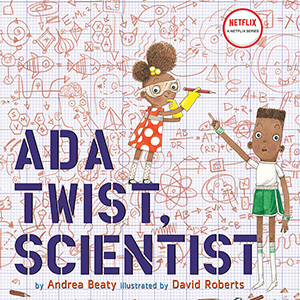
This popular children’s book, written by Andrea Beaty and illustrated by David Roberts, invites little ones to think like scientists, by asking why. The book celebrates the power of curiosity and perseverance, drawing inspiration from real-life makers and famous women in STEM, Ada Lovelace and Marie Curie.
Find a free read-aloud version of this book on Youtube.
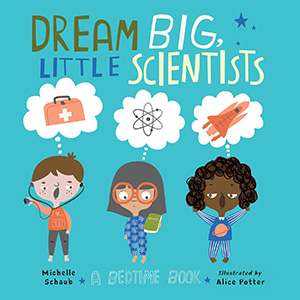
This rhyming board book, written by Michelle Schaub and illustrated by Alice Potter, introduces eleven branches of science – from astronomy to physics to chemistry to geology. The picture book highlights famous scientists in the field and introduces some of the basic lab equipment that scientists use for their experiments.
Find a free read-aloud version of this book on Youtube.
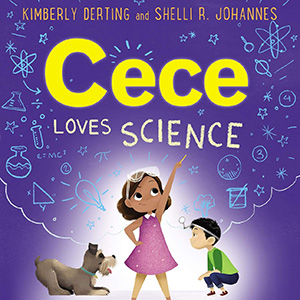
This children’s book, written by Kimberly Derting and Shelli R. Johannes, with illustrations by Vashti Harrison, celebrates curiosity and encourages little ones to ask: Why? How? And What if? The book follows a young girl as she investigates, researches, and collects data for a class project. The story lends itself to conversations with young children about the scientific method.
Find a free read-aloud version of this book on Youtube.
If you are looking for more inspiration and ideas for incorporating science into your early learning program, you might enjoy the following resources:


