

Last week, the Good2Know Network team attended a workshop about preschool activities that support the development of foundational math skills that prepare children for kindergarten. Workshop hosts First 5-Alameda County and Tandem Early Learning demonstrated simple, budget-friendly, easy-to-execute activities that can be incorporated into any early learning program. Most had the added benefit of incorporating free or recycled materials, including items that many ECE programs already have handy!
Below are some of the wonderful ideas shared by the workshop presenters and participants.


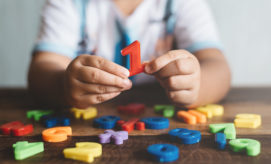
Sorting. Many early childhood programs have small loose parts available that can be easily used for a variety of activities. As children sort these items, they learn important mathematical skills in pattern-matching, categorizing, and number correspondence, all of which are foundational for algebra and other concepts learned later in school. Sorting can be done with buttons, animals, small blocks, colored popsicle sticks, pom-poms, or any other loose parts that you have available!
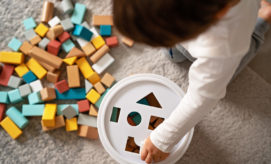
Stacking and building with blocks. Does your program have blocks handy? These could be foam blocks, wooden blocks, or even legos! When children build, they notice the different shapes and sizes of each block. They can experiment with size to see which block will best support their tower, and discover how to build a strong foundation to support their building. These building activities introduce children to geometry and mathematical reasoning.
Mystery bag. Learning about shapes can be a tricky concept for young children to grasp. To help children gain a better understanding, you might consider trying a mystery bag! To make one, place a variety of blocks of different shapes into a bag, and encourage children to reach in and guess the shape based on its feel– before they look at it or take it out. This activity introduces children to different shapes as well as concepts like corners, sides, and curves. Encourage the children to describe what they know from the experience of touching the block, so their other classmates can join them as they learn about and identify the shape.
You might also enjoy the Good2Know article: 5 Ideas for Exploring Shapes with Children during Snacktime!
Simon Says. Did you know that Simon Says can actually be an educational game? Children will learn spatial relationships between objects by figuring out how to place their hands “on top of” or “behind” their head, or make sure they are placing their left foot “in front of” their right. An understanding of spatial relationships and positions of objects helps children to develop a foundational understanding of geometric concepts.
Reading books: While there are many math books available to read with young children that explore shapes and counting, children can learn about early math skills from almost any book! By simply looking at a book’s illustrations and asking children questions like “how many fish do you see on this page?” you can incorporate math skills into storytime. Simply include early math concepts like counting, size comparisons, and shapes into the dialogue you use to engage children in the story.
You can find more math activities for little learners in the Good2Know Network article, Early Academic Skill-building: Exploring Patterns with Young Children.
An important point that was emphasized at the event was the value of articulating the specific learning goals to parents. While parents can observe their children playing, they might not understand the specific learning that is happening, and how the specific materials you’ve selected are contributing to the learning process. To ensure that parents understand the connection between play and learning, it is important to communicate what the children are working on in the classroom.
You might do this by creating a poster for the drop-off and pick-up area, or by sharing a few photos (via email or a parent communication app) with a brief description of the math foundations that children are learning through their play. You might even write a small note to post by the sign-in, sign-out sheets with a message like “Today we played a game to learn about shapes and geometry!”
Parents are always eager to know more about what children are learning at school! When parents understand what is happening in the classroom, they are better able to help reinforce that learning in at-home conversations and activities.