
Play is one of the most powerful ways young children learn and grow. During the early years, children’s play becomes increasingly social, active, and complex as little ones’ bodies and brains develop. When educators understand how play changes throughout development, they can more effectively support each child’s learning and growth. In this article, we explore the stages of play and share simple, practical strategies to support young children’s development through every stage.
Children’s play changes and evolves significantly between infancy and pre-k. Babies and toddlers tend to explore independently, while older children, who have more developed social-emotional skills, are more likely to enjoy play-based activities that involve peer interaction.
The way play develops was studied by researcher and sociologist Mildred Parten, who identified six stages of play during childhood. While there are many ways to look at play and the connection between play styles and child development, Parten’s early theory continues to provide helpful insight for educators. We can use the stages of play categories to observe the way the children in our care are playing, notice the connection between their play and skill-building, and use simple and effective strategies to support their development.
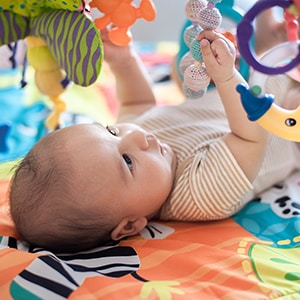
This is the primary form of play for most newborns and young infants. During this stage, children are busy observing their immediate environment and acclimating to their bodies. Unoccupied play might look like a baby observing items around them, such as a ball as it rolls by. While this behavior might not seem like play, it is based on curiosity and exploration, two of the key ingredients of play. Infants engaged in unoccupied play are getting ready to learn through play, by building foundational skills such as:
Educators can support children’s development at this stage by…
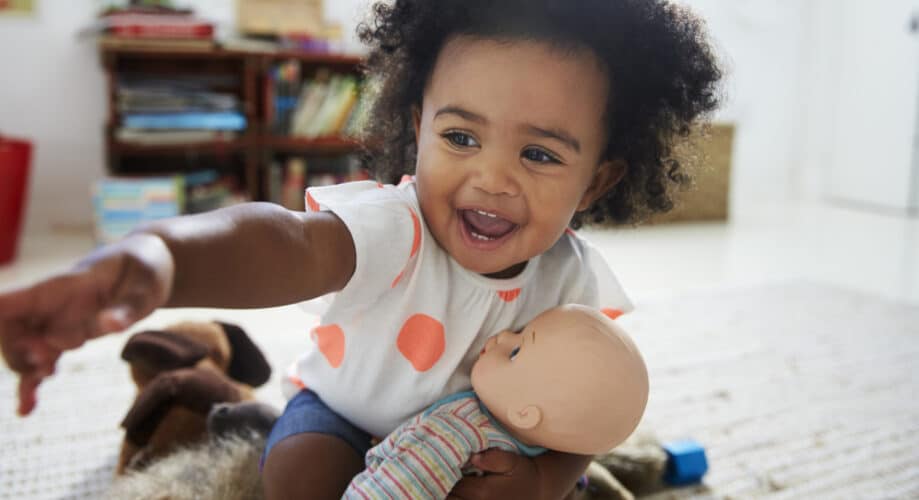
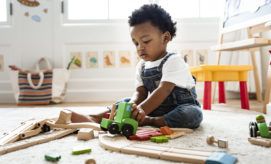
In solitary play, children explore and engage in activities on their own, without involving others nearby. We typically see this type of play emerge in later infancy when little ones are more mobile and able to explore materials independently. Solitary play gives children the opportunity to explore their interests freely and master new skills. During this stage, children are learning and building the following skills:
Educators can support children’s development at this stage by…
Children engaging in onlooker play observe their peers playing, and might demonstrate interest by asking questions or giving suggestions, but they don’t yet enter into play activities with others. This stage opens the door for more social interaction in play and establishes a foundation for later collaboration. At this stage, children are learning and building the following skills:
When children are playing as onlookers, educators might feel tempted to encourage them to join the group. However, it is important to remember that children learn a lot by observing, and that allowing children to join in their own time builds safety, security, and self-confidence. At this stage, we can support children’s development by…
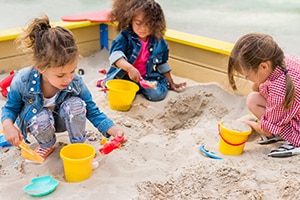
In parallel play, little ones sit side-by-side and engage with similar materials, without directly interacting. This might look like two children playing with different items in the same sensory bin or a group of preschoolers working on individual art projects while sitting next to each other. This kind of play typically begins in toddlerhood, around 2 years old, and is often considered to be a bridge to more advanced types of social play. At this stage, children are learning and building the following skills:
When children are engaging in parallel play, we can support their interests and interactions with other children by…
During associative play, children engage in activities that involve more social interaction, shifting their focus away from the objects they are exploring and toward the children they are playing with. Children enjoying associative play might share materials and occupy the same space as they build with legos or create art, but they do not coordinate their actions to reach a specific shared goal. At this stage, children are learning and building the following skills:
When children are engaging in associative play, we can provide support by…
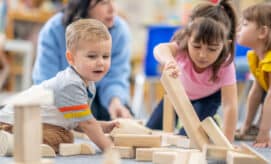
In this stage of play, children’s more developed social skills enable them to interact with their peers in more complex ways. Children play in organized groups that work towards a shared goal or end product. This might look like dramatic play, in which each child has a role and responsibilities that require coordination, communication, collaboration, and problem-solving. At this stage, children are learning and building the following skills:
We can support more complex cooperative play by…
As we incorporate ideas from the stages of play into our work with young children, it is important to note that these stages are not always linear. Children may move back and forth between them, depending on their development, comfort, the classroom environment, and their unique personalities. Some children may spend longer in one stage than another, and some might bring aspects of previous stages with them to new stages. Each child’s journey through play is unique, and all forms of play are valuable for learning and growth.
The Benefits of Play-Based Learning 
Why is Dramatic Play Important in Early Learning?