

Early math skills are an integral part of kindergarten readiness and academic skill-building in early childhood. Incorporating playful movement into mathematics makes learning exciting, and helps children to develop more confidence in their skills. In this article, you’ll find games that use movement to help young children practice important concepts like number sense, shape recognition, pattern matching, and more – all of which will set them up for a smooth transition into elementary school math.
Children feel excited to learn math skills when the skill development is part of a fun, movement game. Incorporating movement is especially beneficial for little ones who have an abundance of energy and often need to get their wiggles out! It allows them to move, jump, and play, while also learning foundational concepts about mathematics.
An article written for the website DREME by Kristen E. Reed and Jessica Mercer of Young Mathematicians, explains that “math games provide a structure and process for children to engage in problem-solving in order to reach a particular goal or objective. Reaching that goal might be challenging, but the challenge is also what makes game-playing fun…In addition to all the foundational mathematics learning going on while they play games, children are building their confidence as problem solvers and practicing important social-emotional skills.”

activity & image from Creative Family Fun
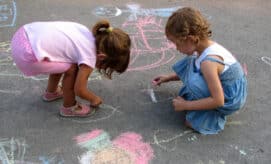
To set up this simple game, all you will need is some chalk and a patch of sidewalk! First, draw several different shapes on the sidewalk that are large enough for children to jump on. (Simple shapes, such as circles, squares, and triangles, are best for younger children; while older learners in preschool and pre-k might enjoy more of a challenge with complex shapes such as octagons, pentagons, and more.) Older children might enjoy helping to draw some of the shapes themselves.
Then, invite the children to engage with the shapes during an outdoor game of hopscotch! Encourage little ones to toss a bean bag onto different shapes and then hop over to them. Or, call the shapes out and have children find and run over to the matching shape. This activity helps children learn about shape recognition and spatial awareness, both of which are key foundational skills for geometry.

This simple game requires nothing but music and room for children to move. Join the children in a space where they can move freely, and then demonstrate a dance pattern, such as stomping, followed by clapping, jumping, etc. Invite children to join the dance as soon as they recognize the movement pattern. Once most children have joined in the dance, say, ‘freeze!’ and ask the children what movement comes next. Continue to play using different movement patterns, such as touching your toes, touching your head, reaching your hands in the air, and more.
This game is a great way for children to get up and move, and to practice pattern recognition by sight, sound, and feel! Find a free printable of this activity from Young Mathematicians here.

activity & image from Hands on As We Grow
To play this game, you will need the following items: a large sheet of paper or multiple pieces of papers taped together, a permanent marker, tape, and balloons. Set up the paper by drawing ten circles roughly the same size as the balloons. Inside each circle, draw dots in quantities from 1-10. Next, blow up ten balloons and write the numbers 1-10 on each to correspond with the dots.
Once the game is set up, encourage children to match the numbered balloons to the circle with the same number of dots inside. To make a match, children will have to count the dots and find the matching numbers, which encourages learning about one-to-one correspondence and number recognition. This activity can be set up indoors or outdoors. Chasing the balloons around and trying to keep them still creates an added challenge that will encourage little ones to move.

ECE Podcast: Building Strong Foundations in Math 

Making Math a Part of Everyday Preschool Routines